Water Heater Leaking? What to Do First
By In A Jam Call Sam
What to do if your water heater is leaking—safe first steps, what the leak location may suggest, and when to call for service.
Water heater leaks aren't all the same — a small drip and an active gas smell call for very different responses. Here's how to tell what you're dealing with, what the leak's location may suggest, and when to call for service.
Do This First
If you smell gas: leave the building or area immediately. Don't smoke or light a match, candle, or other flame. Don't operate light switches, appliances, vehicles, phones, or anything else that could create a spark near the suspected leak. From a safe location, call 911 and your gas utility's emergency line.
If there's active spraying, flooding, or water near an outlet, switch, or your electrical panel: don't touch electrical equipment that's wet, and don't stand in water to reach a breaker panel or switch. Shut off electrical power only if the panel and the path to it are dry and safely accessible. Otherwise, leave it alone and call a qualified professional.
If none of the above applies and the cold-water supply valve is clearly identified and safely accessible — without stepping into standing water or touching hot water — closing it may limit additional incoming water. It does not repair the leak, empty the tank, or guarantee the leaking stops right away. If you're unsure which valve it is, or you can't reach it safely, leave it alone and call for help.
If it's a small, contained drip with no gas smell, no water near electrical equipment, and no scalding risk, it isn't necessarily a 911 or utility emergency — but it still needs prompt professional evaluation. Don't continue using the water heater as though nothing is wrong, and don't assume a small leak will stay small: quick action can make the difference between a minor issue and significant water damage.
Stop and Get Help Immediately If:
You smell gas.
Water is spraying, flooding, or reaching an outlet, switch, or your electrical panel.
The water is scalding hot and actively leaking or spraying.
In any of these situations, don't try to diagnose the problem yourself. Leave the area if needed and contact the appropriate emergency or utility service, then a plumber.
Where the Water Is Coming From
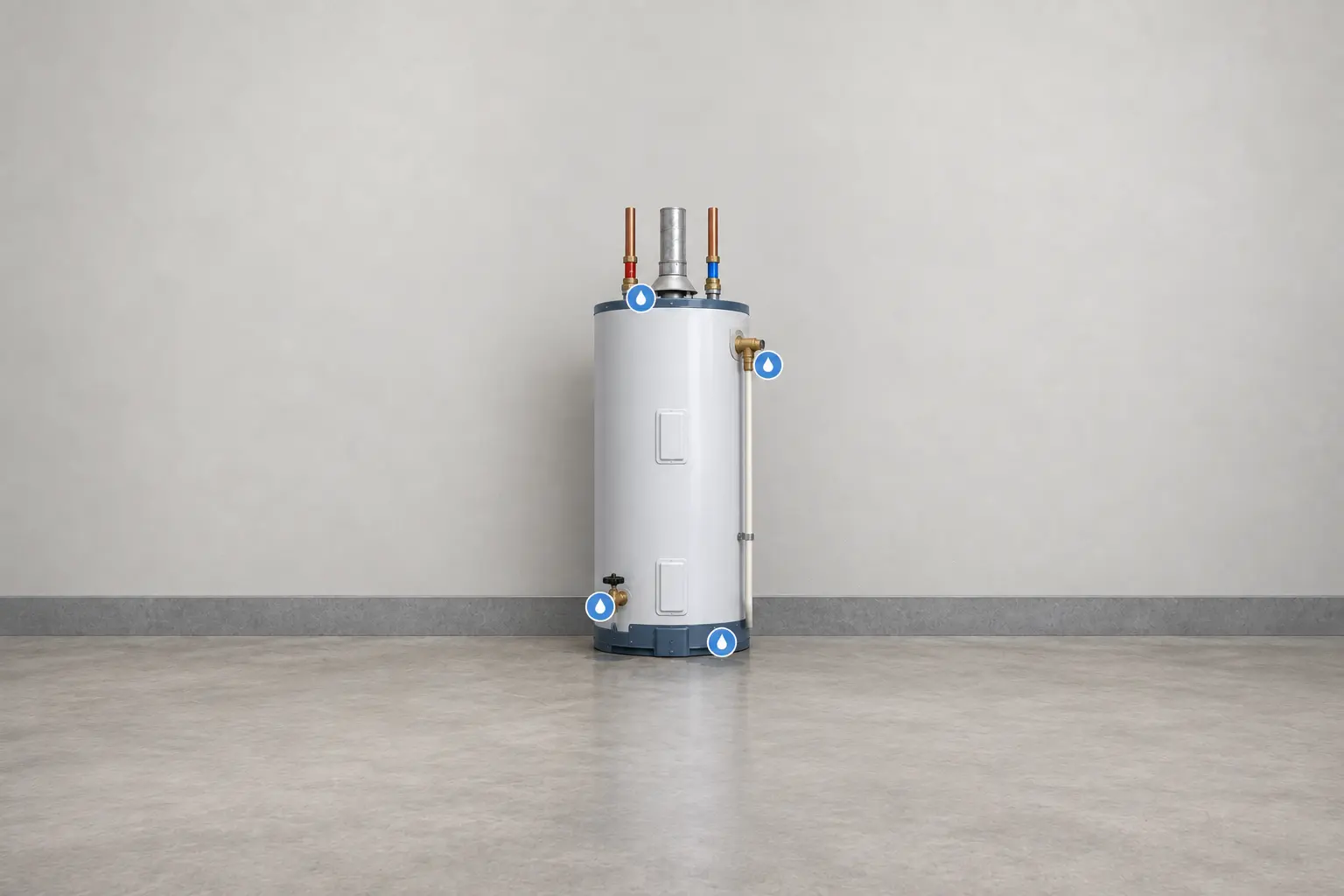
Top or upper connections. Loose or worn fittings at the inlet and outlet connections near the top of the unit are a common source of leaks, and this is often repairable.
The relief-valve discharge area. Moisture at the temperature-and-pressure relief valve or its discharge pipe needs professional evaluation. Don't open, test, cap, block, or adjust this valve yourself.
The drain-valve area. Moisture near the drain valve needs professional confirmation. It shouldn't be assumed to come from the tank body without that confirmation.
Bottom or underneath the unit. Water visible at the bottom doesn't by itself identify where it started — it can travel down from a connection or valve higher up. That said, water pooling around the tank body itself is generally associated with internal corrosion, and manufacturer guidance treats that as a condition that typically requires replacement rather than repair. Confirming which of these is actually happening needs a professional inspection, not a visual guess.
Condensation or another nearby source. Small amounts of condensation on a water heater are normal. Water near the heater may also come from condensation or another nearby source, so the visible puddle alone may not identify the failed component.
Repairable Issue or Possible Tank Failure?
Loose fittings or a failing relief valve are the kinds of issues that are often repairable. Moisture at the drain valve needs the same professional confirmation as any other area — it shouldn't be assumed to be either a simple fix or tank failure on its own. Water coming from the tank body itself — the sealed metal tank, not a valve or connection — is a different situation: manufacturer guidance associates this with internal corrosion, where replacement is typically the practical outcome rather than repair. The distinction matters, and it's exactly what a professional evaluation is for.
What a Professional Evaluation Checks
A proper evaluation identifies exactly where the water is coming from, checks the condition of the connections, valves, and the tank itself, and considers the unit's age and condition. From there, whether repair or replacement makes sense depends on what's actually found — not on guesswork from the outside.
Call (703) 256-0444 · Request Water Heater Service
The Short Version
A water heater leak from a connection, fitting, or valve is often repairable. A leak from the tank body itself usually points toward replacement. Water at the bottom of the unit doesn't confirm which one you have on its own — and if there's a gas smell, active flooding, or water near electrical equipment, leave the area and get help before doing anything else.
Sources
In A Jam Call Sam installs and repairs both storage-tank and tankless water heaters, and can evaluate a leaking unit to determine what it actually needs. If you're in Fairfax or Springfield, service details are on our Fairfax and Springfield pages.


Frequently Asked Questions
Articles you may like
August 17, 2026
Do You Need to Repipe Your Home? The Dangers of Aging Polybutylene Pipes
Frequent leaks, low water pressure, and sudden pipe bursts are major red flags. Learn why the aging pipes inside your Northern Virginia home might be failing, and how to know when it is time for a whole-house repipe.
DISCOVER MORE
August 17, 2026
Why Is My Water Bill So High? 4 Hidden Leaks to Check For
Shocked by your latest water bill? Before you call the utility company to complain, learn how to hunt down the sneaky, hidden plumbing leaks that are quietly draining your wallet in Northern Virginia.
DISCOVER MORE